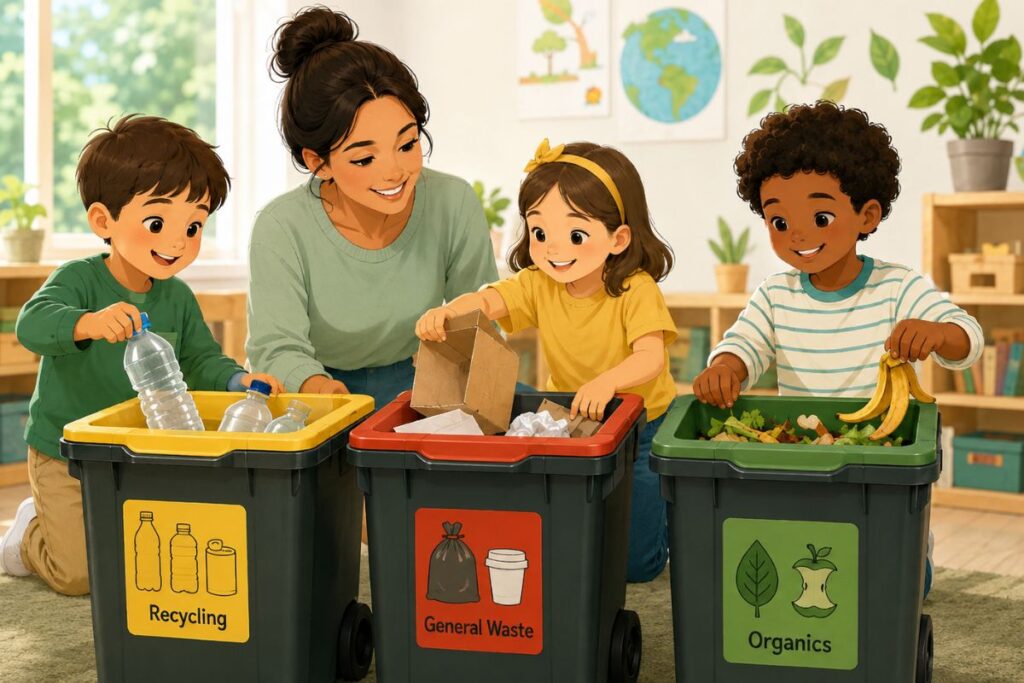
A bottle. A food scrap. A wrapper. A cardboard box.
To an adult, these are ordinary everyday items. To a young child, they can become powerful learning moments.
Recycling education does not need to begin when children are older. It can start much earlier — at home, in day care, in preschool and in everyday family routines. When children learn what different waste items are, where they belong and why their choices matter, they begin to build habits that can stay with them for life.
Learn Recycle was created with this simple idea in mind: early learning can make sustainability practical, playful and easier to understand.
According to the Recycling Behaviours Report 2023, 38 per cent of Australians find recycling confusing. If adults are struggling, it is no surprise that children need clearer, simpler guidance from an early age.
Why early recycling education matters
Recycling is often treated as an adult responsibility. We put bins out, sort packaging, check labels and try to remember what goes where. But many adults still find recycling confusing, especially when rules change between council areas or when packaging looks recyclable but is not.
That confusion matters.
If adults are unsure, children can easily grow up seeing recycling as complicated, inconsistent or unimportant. But when children are introduced to recycling in a simple and age-appropriate way, it becomes part of everyday thinking.
Early recycling education helps children understand that waste does not disappear when it leaves their hands. It goes somewhere. It has an impact. And their choices can make a difference.
Children do not need complex environmental theory to begin learning. They need clear examples, repetition and practical moments they can recognise.
This bottle goes here. This food scrap goes there. This wrapper does not belong in the recycling bin. Small lessons like these can build awareness over time.
The early years shape lifelong habits
The early years are some of the most important years for learning. Children are developing language, memory, problem-solving, social awareness and daily routines. They learn by watching, copying, asking questions and repeating familiar actions.
That is why recycling education should not be left until later.
When children between the ages of 3 and 8 are introduced to simple sustainability habits, they are not just learning about bins. They are learning responsibility, decision-making and care for the world around them.
A child who learns to pause before throwing something away is practising a valuable habit
A child who asks “Can this be recycled?” is already thinking critically
A child who sorts waste correctly is learning that small actions have consequences
These are not just recycling skills. They are life skills.
Children learn best through everyday actions
Young children learn best when ideas are connected to real life. Recycling is perfect for this because waste appears in everyday moments: snack time, lunch boxes, craft activities, shopping, cooking, school routines and family outings.
🍌 A banana peel after lunch can start a conversation about food scraps and compost.
🥛 An empty milk bottle can introduce the idea of recycling containers.
📦 A cardboard box can become a hands-on sorting activity for the whole family.
🍬 A wrapper can help children understand that not everything belongs in the recycling bin.
When learning is connected to something children can see, touch and use, it becomes easier to understand. This is where play becomes powerful. Through games, scanning, sorting and visual learning, children can practise recycling decisions in a way that feels natural.
Why recycling can be confusing for families
Recycling sounds simple, but in practice it can be confusing. Different councils may have different rules. Some items have recycling symbols that do not mean they can go in the household recycling bin. Soft plastics, food-contaminated packaging, coffee cups, batteries, electronics and mixed-material packaging can all create confusion.
This confusion affects families and classrooms too. Parents may not always know the correct answer. Teachers may not have simple child-friendly tools. Children may copy habits without understanding why an item belongs in one bin and not another.
That is why recycling education needs to be clear, visual and practical. Children should not have to memorise complicated rules. They need simple guidance that helps them recognise common items and make better choices.
Turning waste sorting into play
For young children, play is not just entertainment. Play is how they learn. When recycling is turned into a game, children can practise decision-making without feeling pressured. They can try, make mistakes, correct themselves and learn again.
A recycling game can help children ask:
Instead of seeing recycling as a chore, children begin to see it as something they can understand and participate in. When children are given age-appropriate responsibility, they feel capable. They want to contribute. They want to do the right thing. Recycling education gives them a meaningful way to help.
How Learn Recycle supports children, families and classrooms
Learn Recycle is a free Australian educational recycling app designed for children aged three to eight. It gives children a simple, visual and interactive way to practise recycling through play — whether at home, in day care, in preschool or in the classroom.
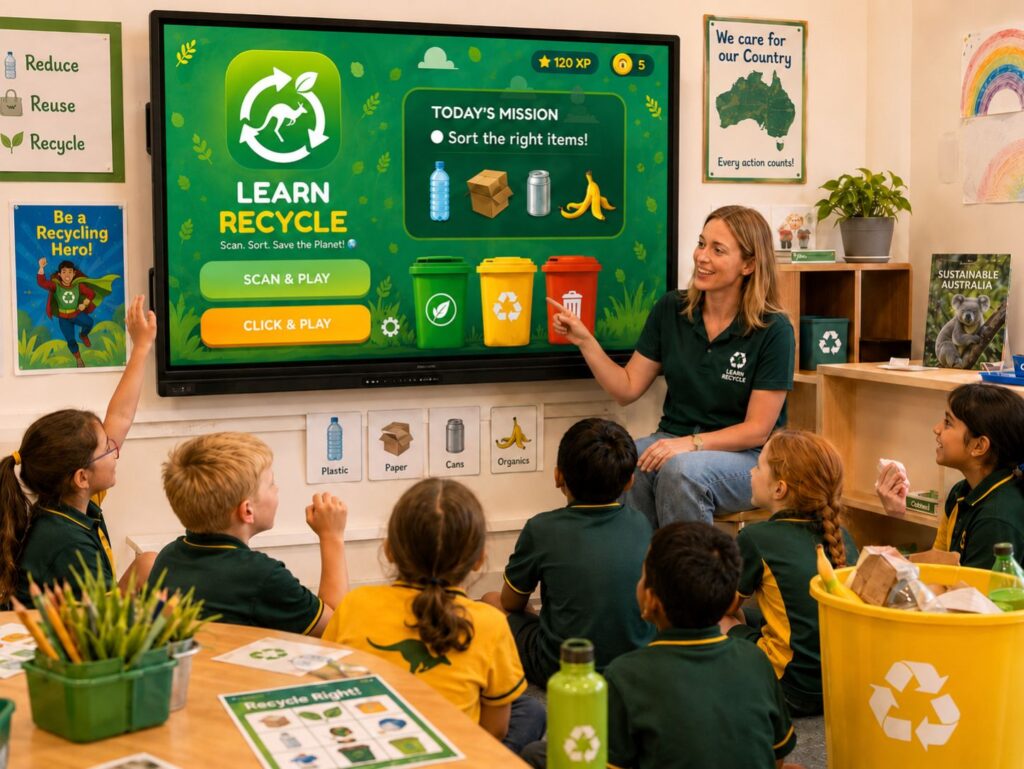
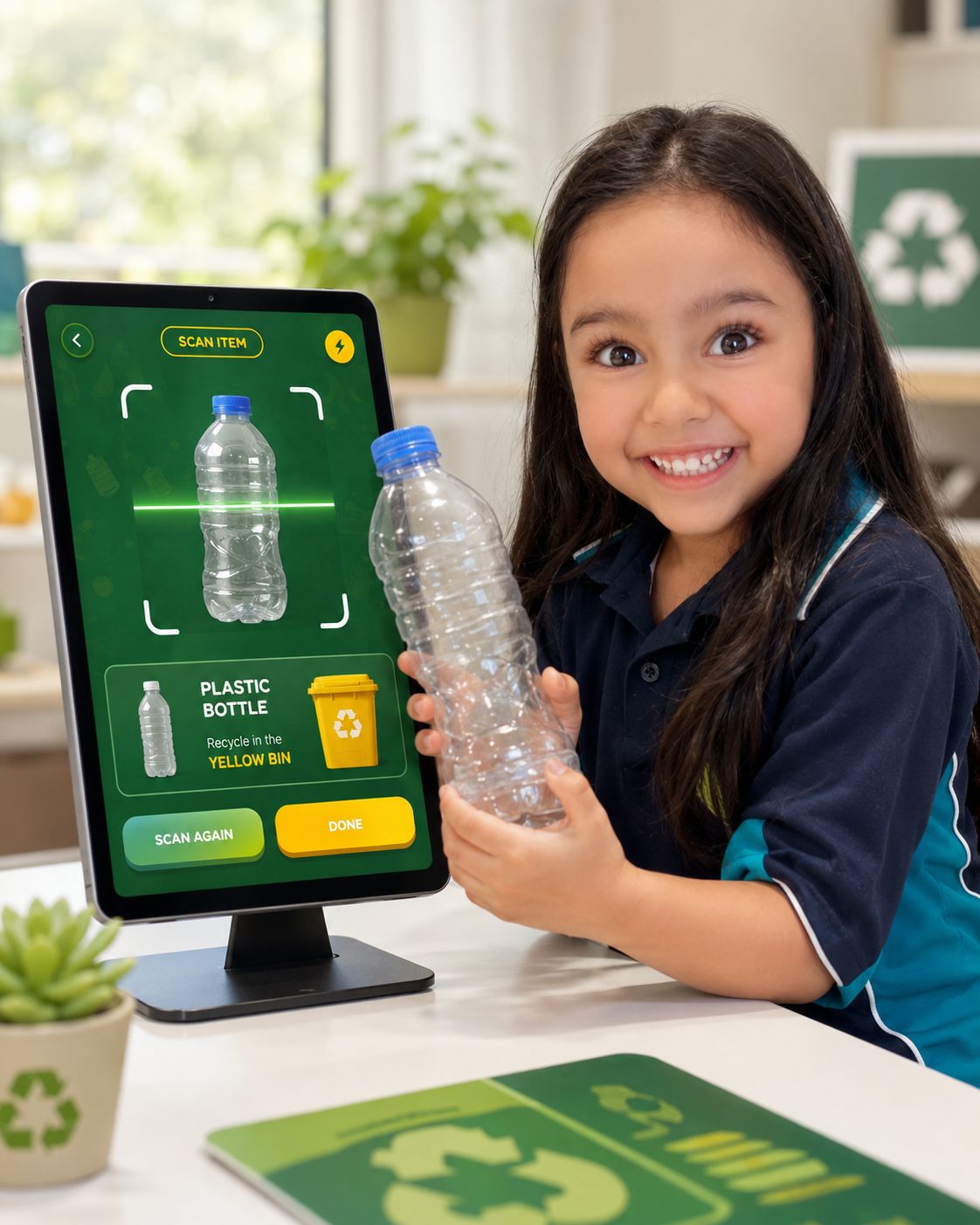
Using two simple modes — Scan and Play and Click and Play — children can scan real everyday items or choose items inside the app, then drag them into the correct bin: Compost, Recycling or Rubbish. The app gives instant friendly feedback, showing children whether they chose correctly and explaining where each item belongs when they get it wrong.
Learn Recycle was created by Kiaan, a young Australian student who began developing the app at age eight. He wanted to help younger children understand recycling in a way that felt simple, visual and genuinely fun.
For families, Learn Recycle turns daily waste moments into learning opportunities. For educators in day care, preschool and early primary settings, it can be used in group sessions on a shared tablet or interactive screen. No complicated setup, no special equipment and no cost.
Why schools and early learning centres matter
Schools, preschools and early learning centres play an important role in shaping daily habits. Children often learn routines in groups. They watch their teachers. They copy their friends. They practise shared responsibilities. A classroom recycling system can help children connect learning with action.
When recycling education is included in early learning, it can support broader lessons around sustainability, responsibility, community care, problem-solving, science and the environment. These ideas do not need to be taught in a complicated way. They can be introduced through games, sorting activities, classroom discussions and everyday waste decisions.
A simple bin activity
becomes a lesson in responsibility
A recycling game
becomes a lesson in problem-solving
A classroom routine
becomes a lifelong habit
A small habit that can grow into lifelong awareness
Recycling education is not only about knowing which bin to use. It is about helping children understand that their actions matter.
When children learn early, they begin to see themselves as part of the solution. They learn that caring for the environment is not something only adults do. It is something everyone can practise, one small choice at a time.
That is why recycling education should start before school. Not because young children need to carry the burden of environmental problems, but because they deserve the chance to grow up with better tools, clearer understanding and stronger habits.
Learn Recycle was built to support that journey. By turning everyday waste into playful learning moments, we can help children build practical recycling awareness from the beginning.
A bottle today. A wrapper tomorrow. A better habit for the future.
Learn Recycle Team
Australian educational recycling initiative · learnrecycle.com.au
Early Childhood
Sustainability