Most Australian families want to recycle correctly. The problem is that recycling rules are not always clear, consistent or easy to remember — especially when you are trying to explain them to a young child at the same time.
This guide is designed to make it simple. It covers what goes in the recycling bin, what does not, what surprises most families and how to turn everyday waste sorting into a learning moment for young children.
The three bins most Australian households use
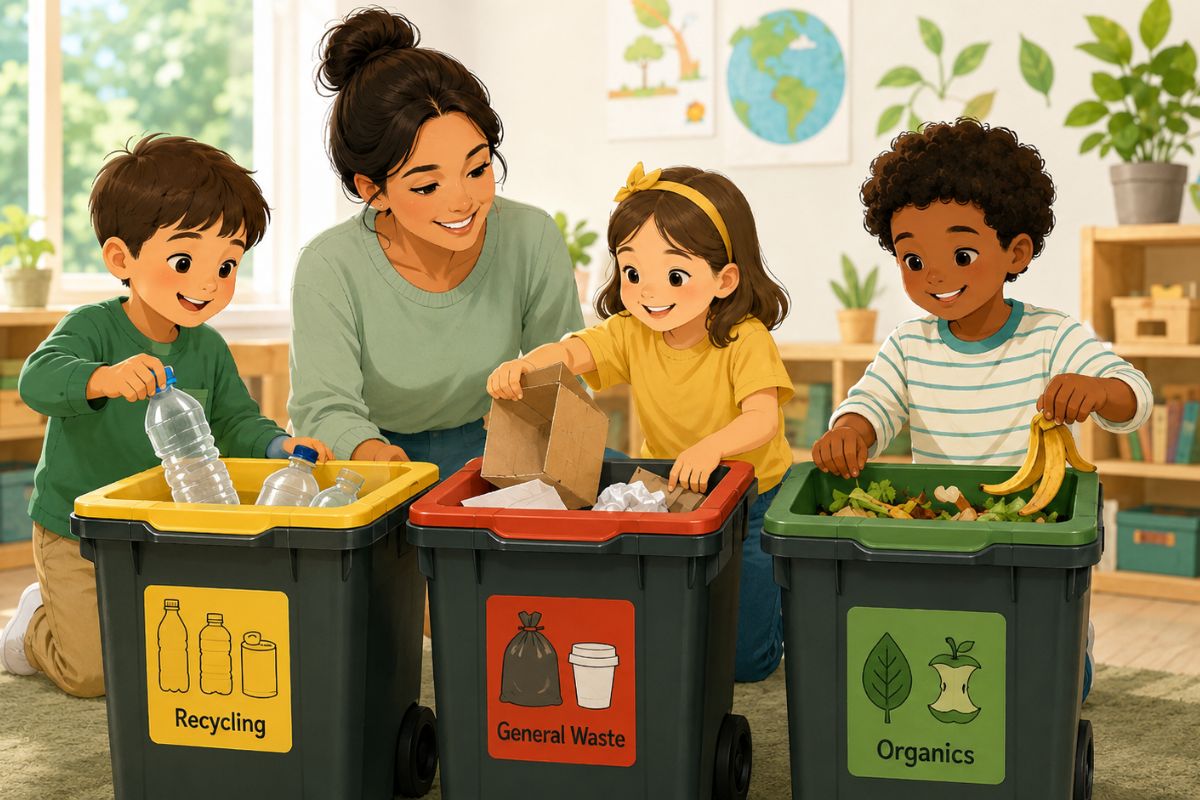
Before we talk about what goes where, it helps to understand the three bin system used across most of Australia.
Recycling Bin
Usually yellow lid
Clean, dry materials that can be processed and made into something new.
General Waste Bin
Usually red lid
Items that cannot be recycled or composted. This goes to landfill.
Food and Garden Bin
Usually green lid
Food scraps, garden waste and organic material that can be composted.
Not every council offers all three bins. Always check your local council website for the specific rules in your area.
What goes in the recycling bin
These items are accepted in most Australian household recycling bins. They must be clean, dry and loose — not packed inside bags.
📄 Paper and Cardboard
🍶 Plastic Bottles and Containers
🫙 Glass Bottles and Jars
🥫 Steel and Aluminium
🥛 Cartons
What does NOT go in the recycling bin
This is where most families get it wrong — and it is not their fault. Many of these items look recyclable but cause serious problems at recycling facilities.
Soft Plastics
Soft plastics such as plastic bags, bread bags, frozen food bags, chip packets, cling wrap and bubble wrap should not go in the household recycling bin. They can jam sorting machines. Some areas now have supermarket or special collection options, but availability varies. Check your local council or supermarket collection program before dropping them off.
Food-Contaminated Packaging
Pizza box rules vary by council. In many areas, clean cardboard can go in recycling, while heavy food scraps should be removed. If the box is very greasy or covered in food, check your local council guidance.
Coffee Cups
Disposable coffee cups have a plastic lining that makes them very difficult to recycle. Most cannot go in the household recycling bin. Check your local council for drop-off points.
Batteries and Electronics
Batteries are hazardous and must never go in any household bin. Old phones, chargers, cables and electronics need to go to an e-waste drop-off point. Many supermarkets and hardware stores have battery collection bins.
Polystyrene
Foam packaging, polystyrene cups and trays cannot go in the household recycling bin. Check your council for polystyrene drop-off locations.
Broken Glass and Nappies
Broken glass is a safety hazard for recycling workers — wrap it carefully and place in general waste. Nappies go in the general waste bin.
The items that confuse most families
Some items sit in a grey area and cause the most confusion. Here is a quick guide to the most common ones.
🍕 Pizza boxes
Tear off the clean top — recycle it. The greasy bottom goes in general waste or compost.
🥚 Egg cartons
Cardboard egg cartons are recyclable. Polystyrene egg cartons are not.
🫙 Lids and caps
Rules vary by council. Check locally. Small lids under 50 cent coin size are too small for most sorting machines.
🌯 Aluminium foil
Recyclable when scrunched into a ball larger than your fist. Small pieces are too small for sorting machines.
🥛 Juice and milk cartons
Yes — recyclable in most Australian councils. Milk and juice cartons are accepted in many Australian household recycling systems, but rules can vary by council. Check your local council guide if unsure.
🧾 Receipts
Most thermal paper receipts are not recyclable because of the chemical coating. They go in general waste.
Quick reference — items children see every day
Here is a simple reference for the items young children encounter most often at home and at school.
A note on contamination
Contamination is one of the biggest problems in Australian recycling. When non-recyclable items are placed in the recycling bin — especially food waste, soft plastics or liquid — they can contaminate an entire load of otherwise recyclable material. That contaminated load often ends up in landfill anyway.
This is why rinsing containers, keeping soft plastics out of the recycling bin and making sure items are actually recyclable before placing them matters. Teaching children to rinse, sort and think before they throw is one of the most practical and lasting contributions recycling education can make.
How to explain recycling to young children
Young children do not need to memorise every rule. They need simple, visual and repeated learning that connects everyday items with the right bin. Here are a few approaches that work well for children aged three to eight.
Use the three categories simply
Teach children three things: what can be recycled, what goes in compost and what goes in rubbish. Keep it visual and consistent.
Connect items to what they already know
A milk bottle is something they drink from every day. A cardboard box is something toys arrive in. Starting with familiar items makes recycling feel relevant.
Let them sort
Give children an empty box and let them sort clean packaging into piles. Make it a game. Ask questions: where do you think this goes? Why?
Make it a habit, not an event
The most effective recycling education happens in small, repeated moments. After every meal, after every shopping trip. Small questions asked consistently build real understanding over time.
How Learn Recycle helps children practise sorting
Understanding what goes in the recycling bin is one thing. Practising it regularly is another.
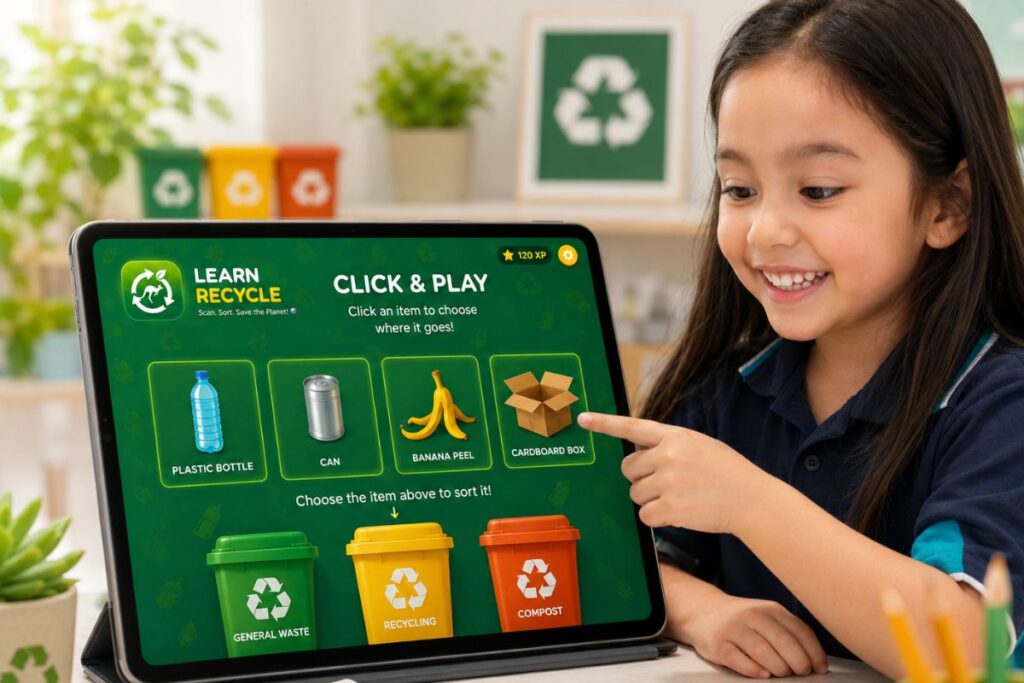
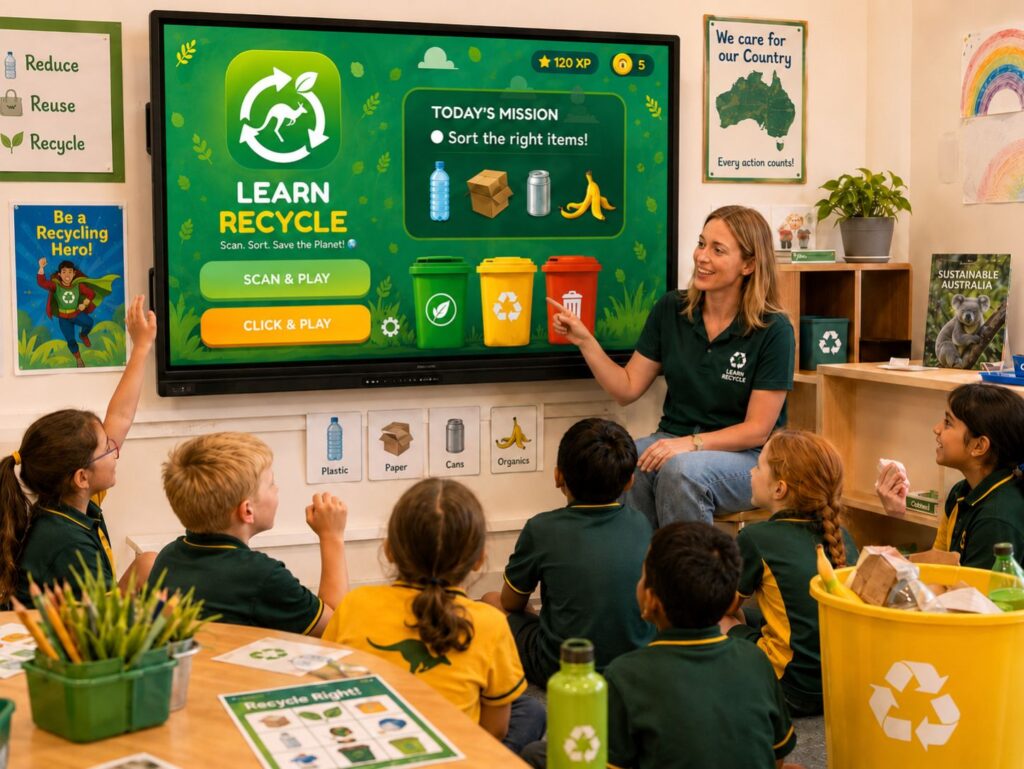
Learn Recycle is a free Australian educational recycling app designed for children aged three to eight. It turns waste sorting into an interactive game where children scan real everyday items or choose items inside the app and drag them into the correct bin — Compost, Recycling or Rubbish.
The app gives instant friendly feedback. When a child gets it right, they are rewarded. When they get it wrong, the app shows them the correct bin and explains why. This is the same cycle of practice, feedback and improvement that builds real understanding over time.
Learn Recycle was created by Kiaan, a young Australian student who began building the app at age eight. It is free to download on the Apple App Store with no subscriptions and no in-app purchases.
The most important rule of all
When in doubt — leave it out.
If you are not sure whether an item is recyclable, it is better to put it in the general waste bin than to contaminate a full load of recycling. A helpful principle to teach children too.
Learn Recycle Team
Australian educational recycling initiative · learnrecycle.com.au
Australian Families
Kids and Recycling